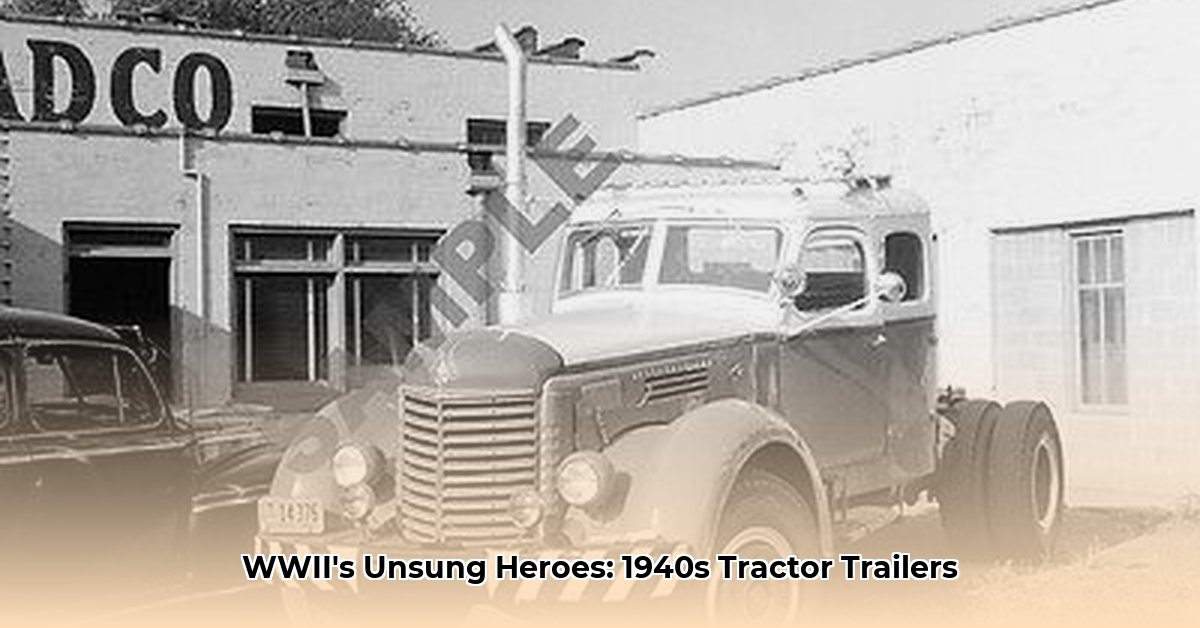
1940 Tractor Trailers: The Unsung Heroes of WWII Logistics
World War II wasn't solely fought on battlefields; the movement of millions of soldiers and mountains of supplies across continents formed a crucial logistical battle. This article explores the vital role of 1940s tractor-trailers, focusing on Fruehauf Trailer Company and International Harvester's contributions to the Allied war effort. These weren't just trucks; they were the lifeblood of the war, the arteries pumping essential resources across the globe. How did these seemingly simple machines contribute to the Allied victory? The answer lies in their design, production, and the contrasting strategies employed by these industrial giants. For more on trailer dimensions, see typical dimensions.
Giants of the Road: Fruehauf and International Harvester
Two titans of the trucking industry, Fruehauf Trailer Company and International Harvester (IH), played pivotal roles in this logistical marvel. Fruehauf, already a dominant force, secured massive government contracts, producing a staggering 6,865 trailers valued at $150,986,000 (in 1940s dollars) – a testament to their scale and impact. These were massive semi-trailers, built to handle long distances and heavy loads, becoming workhorses of America's nascent interstate system. But was this mass-production approach the only effective strategy?
International Harvester took a different, equally important approach. Instead of mass-producing a single design, IH offered a diverse range of trailers tailored to specific needs and terrains. Their 1940 catalogs showcase this adaptable approach – trailers for hauling tanks across rugged landscapes, transporting delicate medical supplies, and ensuring quick maneuvering in confined areas. While precise production figures remain elusive for IH, their catalog clearly demonstrates a significant contribution to the war effort, tailored to the diverse demands of military logistics.
A Tale of Two Manufacturers: Different Strategies, Shared Victory
Fruehauf's documented contribution was immense, showcasing their commitment to mass production of standardized trailers. However, International Harvester's contribution, though less precisely documented, was equally significant due to its adaptability. Their flexible approach offered custom solutions to the diverse demands of various theaters of war. Did one strategy prove superior? The question highlights the complexity of wartime logistical needs and the remarkable ingenuity of both companies. What challenges did each company face in meeting the war's demands?
Design and Production: A Closer Look
Both Fruehauf and IH utilized steel, a critical wartime resource, employing standard welding techniques. However, their strategies diverged. Fruehauf prioritized mass production of standardized trailers, ensuring maximum efficiency to meet massive wartime demands. International Harvester, conversely, focused on versatility, designing trailers with varying sizes, braking systems, suspension types, and hitch options – a direct response to the widely differing terrain and operational necessities of the war.
The Lasting Impact of Wartime Innovation
The impact of these 1940s trailers extended far beyond the battlefield. Wartime logistical demands spurred innovations in design, manufacturing, and supply chain management, profoundly shaping the post-war trucking industry. The need for efficient mass production led to advancements in standardization, while the diverse military needs pushed manufacturers towards versatility. These advancements laid the groundwork for modern supply chains. How did these wartime innovations directly influence contemporary logistics practices?
Unanswered Questions and Ongoing Research
Despite the undeniable impact, many questions remain. Further research into company archives and military records could provide a more complete picture of each company's contribution. Comparing trailer models and analyzing their performance in various theaters of war could offer invaluable insights. What specific areas of research promise to shed light on the less explored aspects of this crucial historical contribution?
Key Differences: Fruehauf vs. International Harvester (1940)
| Feature | Fruehauf | International Harvester |
|---|---|---|
| Production Focus | Mass production, standardized designs | Diverse range of designs, adaptable solutions |
| Trailer Types | Primarily large semi-trailers | Wide variety of sizes and specifications |
| Documented Value | $150,986,000 (in 1940s dollars) | Unclear, further research needed |
| Documented Units | 6,865 units | Unknown, further research needed |
The story of these trailers stands as a testament to human ingenuity and the vital role of logistics in winning World War II. It's a continuing narrative, inviting further exploration to fully understand its impact.
How Did WWII Trailer Designs Impact the Post-War Trucking Industry?
The Second World War profoundly reshaped the American trucking industry. The massive logistical demands necessitated stronger, more durable, and efficient trailers. This spurred innovation in materials (steel replacing wood), suspension, and loading/unloading mechanisms. The wartime focus on mass production made post-war trailer production significantly faster and more cost-effective. Furthermore, rigorous military standards led to greater safety and standardization in civilian designs. The post-war economic boom and the expanding interstate system created a massive demand that these improved trailers were perfectly positioned to satisfy. How did the legacy of these wartime developments contribute to the growth of post-war American commerce?